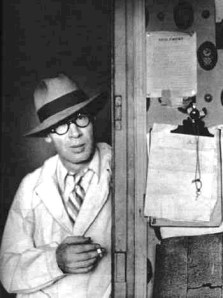
Henry Miller’s Childhood Reading

Henry Miller

Henry Miller is a good example of how childhood reading has a powerful effect on the kind, and style, of work writers produce as adults. (Image: public domain.)

I enjoy comparing my own adventures among books with those of famous authors. All writers, whether they are well known, obscure, or as yet unpublished seem to have a lot in common. However, there are exceptions. Henry Miller, author of oft-banned books such as Tropic of Cancer, seems to be one of them.

In The Books in My Life, Miller describes his vivid memories of books read during his childhood. He has astonishingly clear recollections of covers, illustrations, historical eras, famous people, even where he first encountered certain words. Looking carefully at that list of recollections, I decided he must have been a heavy reader of non-fiction. It struck me how much Miller’s rememberings differ from my own memories of youthful encounters with books.

Continue reading “Henry Miller’s Childhood Reading”

Solitude Can Generate Chaotic Thoughts and Negative Moods

Scientists believe the natural state of the human mind is chaos. Since it lacks innate order, something must happen to keep the mind in an orderly state. To put this in practical terms, it means that when people are alone, with nothing to do, their thoughts tend to become disordered and their moods negative. They suffer psychic entropy.

Empty path in park dusted with snow

A little solitary time can be restful, but for most people, spending too much time alone allows a disordered mind which then generates negative moods.

The neuropsychologist George Miller said, “The mind survives by ingesting information.” When no information is available to keep it in an ordered state, the mind begins to lose control of attention (i.e. it begins to “wander”), at least temporarily. Most people instinctively understand this and deal with solitary time by taking up pastimes such as watching TV, reading, listening to music, thumbing through magazines, or surfing the net. They deliberately expose themselves to an external information source. What’s more, when faced with the prospect of solitary time away from home – with its habitual pursuits – they prepare by buying a magazine or a paperback book, or by taking their iPod or laptop with them.

Continue reading “Solitude Can Generate Chaotic Thoughts and Negative Moods”

Personal Transformation Through Writing

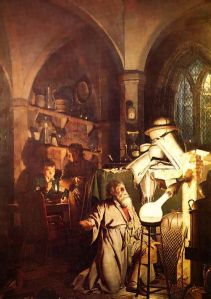
Alchemy was the medieval forerunner of chemistry. It was particularly concerned with trying to convert base metals (such as lead) into gold or to find a universal elixir – more popularly known as the philosopher’s stone – that would perform the conversion upon contact. In recent times, the word alchemy has evolved to indicate any process of transformation, creation, or combination that seems magical.

Alchemist kneeling beside his alembic

Writing over a long period can be a powerful alchemical process of personal transformation. (Image: public domain.)

Even the ancients realized that alchemy is as much about refining the alchemist as it is about distilling some raw material into the philosopher’s stone. Jung popularized this notion in his writings. In this process of self-refinement, the alchemist must pass through three stages:

Continue reading “Personal Transformation Through Writing”

Fantasy Writers and the Sense of Enchantment

There are many reasons why people write. Each writer has a reason of their own, and no two are exactly alike. Much of my writing is fantasy. Why that is so may help you understand your own impulse to write fiction of one kind or another.

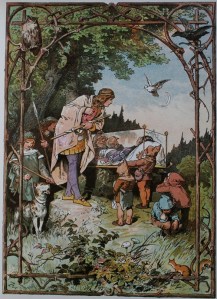
Scene from Snow White and the Seven Dwarves

Writers are often trying to recapture a favourite mood. Work after work is produced as they hone in on the cherished feeling tone, which can be quite specific and durable. (Image: public domain.)

Like so many people, when I was small I possessed a powerful ability to enter a state of enchantment. The feeling prospered until, at twelve, a broken heart drove enchantment from my life completely. How deeply we feel things at that age! Luckily, not all was lost. There were books in the world. My love of reading soon rekindled the magical feeling. It disappeared again during the trials and tribulations of late adolescence. This time I was more aware and made strenuous efforts to retain it. Those efforts were of no avail. The loss of enchantment made life seem grim and not terribly worthwhile. Thinking that enchantment was a thing for children, I entered adulthood in a sadly disillusioned state.

Continue reading “Fantasy Writers and the Sense of Enchantment”

Make Your Story’s Setting Work For You

The most powerful way to depict setting is with telling details that affect and influence characters in the same way as does plot. The technique adds unity by tying the setting to the story’s characters. They are not just in the setting; they are interacting with it. How characters respond emotionally to the setting allows readers to identify and empathize with them. We all know what it is like to enjoy or dislike a particular place. When writers have their characters tell what they feel, readers will, based on their own personal preferences, agree or disagree. Either way, their feelings are engaged.

You can develop a character by showing how he or she reacts to your setting and why. (Image: public domain.)

Continue reading “Make Your Story’s Setting Work For You”

Do Indie Writers Need a Pen Name?

Some indie writers operate under a carefully chosen pen name. Is there an advantage to this? Does it increase the author’s ability to sell his or her works? When I set out to become an indie, I thought the strategy had some merit. Subsequently, I had cause to reconsider.

Mark Twain

Mark Twain is probably the most famous pen name. A special nom de plume can make you stand out, but there are other pros and cons. (Image: public domain.)

About two months after I decided to become an indie author, I discovered that I would not have, as I confidently expected, exclusive use of my somewhat unusual surname in the fantasy genre. I finally thought to search Smashwords for “Cotterill” and found that one Rachel Cotterill (in the UK) has two fantasy novels already listed on the site. The “Cottrell” spelling of our name is common, but “Cotterill” is much rarer so this seemed a bit of bad luck. It is not that I begrudge Rachel Cotterill the use of the name, naturally, but I had the idea that a unique surname would give me an advantage in making sales. After all, a search that brings up only your books must be better than one that brings up a whole list of books by people with the same name; right?

Continue reading “Do Indie Writers Need a Pen Name?”

How to Develop Your Story Idea into a Plot

Overview

Here are some insights into the process of turning a basic story idea into a structured plot. The brief discussion is tailored for the writer of plot-dominated stories or genre fiction.

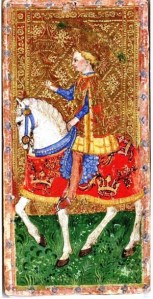
Tarot card showing a knight on horseback

The hero of your story faces change and must struggle against a villain to reach a clearly stated goal.

Start with a Critical Moment of Change

All stories start with an idea, but an idea is only the kernel, the seed. The way to transform an idea into a story is to generate a plot. Within the context of your idea, begin with a moment of change for the main character. This has power because change of any kind is threatening. Right away, the reader wants to know how your character will deal with the threat. Therefore, the realization of change is the point where your story begins. To work well, the change must be of sufficient depth and seriousness; it must matter to the character; it must be something the reader can relate to and identify with.

In essence then, a situation exists, but something important has changed. The main character is threatened. Their position is no longer secure. They vow to struggle. They choose a goal and take action towards achieving it. Bingo! The story is underway. Once things are moving, the main character must encounter a variety of difficulties, complications, and opposition. Make sure there are many fights (these can be merely verbal). The main character, or “hero,” needs a rival, the “villain,” with goals that oppose and conflict with the goal chosen by the hero at the beginning of the story.

Continue reading “How to Develop Your Story Idea into a Plot”

Ebook Covers for Indie Writers

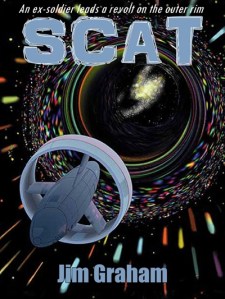
Demonstration Ebook Cover for the sci-fi novel SCAT.

After finding the public domain artwork, I made this cover in fifteen minutes using a donationware application called PhotoScape.

As an indie writer who has not yet made his fortune it does not pay me to have ebook covers made by professionals. This is especially true for short stories. That being the case, I learned – like most indies – to make my own covers. I manage my ebook collection with Calibre and since that stellar application allows me to add covers to public domain ebooks, or even replace covers on DRM-protected works, I set aside a little time each day to create covers for the assorted ebooks that most needed them. It does not take long to get reasonably good at this.

The biggest headache for the ebook cover maker is the infamous copyright issue. Luckily, as long as you are only making the cover for personal use this is not a problem. That happy situation means just about everything on the Google image search is up for grabs. Once you have decided on the subject matter for your ebook cover it does not take too long to scare up a suitable candidate or two.

Continue reading “Ebook Covers for Indie Writers”

Review: Birdie Down by Jim Graham

Birdie Down - cover

This one is usually free at Smashwords. Why not enjoy an exciting read that costs you nothing?

Birdie Down is Jim Graham’s second novel and a science fiction version of what Rudyard Kipling would have called a “ripping good yarn.” What we have here is high adventure of the best kind with a motley collection of crashed revolutionaries and hostages struggling to survive on a jungle planet rife with bad weather, deadly creatures, and hostile enemy forces. The odd dose of rank treachery adds even more spice to the rich mix.

The book opens with some solid foundation-laying. Birdie Down is an episode within the greater story told in Graham’s first novel, Scat (see my review), and early chapters provide the tie-in. We soon reach the story’s heart.

Continue reading “Review: Birdie Down by Jim Graham”

Human Beings Are Always Half-Asleep

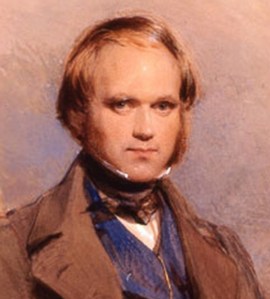
Young Charles Darwin

Evolution recognizes that humans are a work in progress. We are not yet, and perhaps never will be, completely conscious. (Image: public domain.)

In spite of our fond beliefs to the contrary, we Homo sapiens are not yet a fully conscious species. Perhaps our need for sleep reflects this reality, for the old argument that we must slumber while our bodies repair themselves does not withstand the verifiable truth that there are those who get by on just thirty minutes each “night.” These alert folk also demolish the idea that sleep is necessary to facilitate integration of the day’s experiences.

What purpose then, do our somnolent ways serve?

Continue reading “Human Beings Are Always Half-Asleep”