Intuitive Insights Can Be Slow In Coming

The common perception of intuition is that it is blindingly fast, an almost instantaneous comprehension of some problem, question, or situation. In fact, definitions of intuition often describe it in precisely this way. The Concise Oxford English Dictionary says, “… the ability to understand something immediately, without the need for conscious reasoning.” In reality, when solving complex problems, intuition can be extremely slow. Sometimes, years may pass before the needed insight suddenly emerges into conscious awareness.

Rainer Maria Rilke, 1900

While it might end in a sudden epiphany, the lyric poet Rainer Maria Rilke saw intuition as a years-long process. (Image: Wikipedia)

Rilke’s Advice to a Young Poet

In 1903, the great lyric poet Rainer Maria Rilke wrote ten letters to a student seeking guidance. In the course of giving advice, Rilke reveals an attitude of patience towards garnering insights that would remain with him throughout his life. He reiterated this idea near the end of his days when, living in his lonely stone house in the Swiss countryside, he was finally able to complete his masterpiece, “The Duino Elegies,” which had been a decade in the making.

Continue reading “Intuitive Insights Can Be Slow In Coming”


Disliking Yourself

Inner emptiness, the inability to tolerate being alone are symptomatic of a lack of self-knowledge, a poorly defined sense of self. Sufferers often describe the chronic condition as a feeling of loneliness. People with this problem usually have a desperate need for the regard and affection of others, said regard and affection providing the means to ward off, or at least ameliorate, painful self-dislike. Since they cannot accept themselves, they have a powerful need to forget themselves, to get out of themselves, to do something, anything, which will promote self-forgetfulness, self-oblivion. Psychologists claim that a lack of happy family life in childhood may lay the foundations for such a plight. A child unloved by its parents never learns to love itself.

Eleanor Rigby Statue in Liverpool

Like The Beatles’ “Eleanor Rigby,” you may experience self-alienation as a feeling of intense loneliness or inner emptiness. (photo: Erik Ribsskog)

Continue reading “Disliking Yourself”

The Purpose of Consciousness Is Language

The sense of loneliness and yearning for something beyond personal needs, something lost or forgotten, some Eden is the longing to return to a state of unconscious union with the world, an abolition of fretful ego in favour of carefree unknowing, a state like that of crocodiles basking on the river-bank with a belly full of fish. All is well! All is right with the world! We hunger for sheer, unadulterated, unexamined contentment. In short, we want to regain the childish condition Jung so aptly called the “participation mystique,” the situation where, as small children, we could not tell what was “us” and what was the world.

Painting depicting people in conversation

The purpose of consciousness is language which enables us to communicate and co-operate. (Photo: Wikimedia)

Continue reading “The Purpose of Consciousness Is Language”

Review: Sylvia’s Lovers by Elizabeth Gaskell

From a masculine standpoint, Sylvia’s Lovers is not a promising title for a novel. It sounds like a Harlequin romance when, in fact, it is a marvellous evocation of life in a rugged Yorkshire whaling town in the late 1700s. The English are at war with the French (again) and the vividly depicted harbour town bustles with whaling activity while the King’s press gangs roam the narrow streets looking for able-bodied sailors they can strong-arm into a navy desperate for new recruits. As they make their daily rounds, the locals must walk furtively, resentfully watchful for the hated gangs. Emotions run high. There are outbreaks of violence.

Sylvia's Lovers cover

Gaskell’s engrossing novel of life and love in an 18th-century English whaling town deserves to be more widely read.

The lovers of the novel’s title are Philip Hepburn, an intelligent stooping local shop clerk, and Charley Kinraid, a fine figure of a man who is a daring harpooner on a whaling ship. Sylvia is a pretty farm girl with an aversion to all book learning that does not involve the “Greenland seas” where the romantic Kinraid plies his perilous icy trade. The classic love triangle sets up when Philip loves Sylvia but she falls hard for Charley Kinraid after he is wounded while bravely defending his shipmates from a press gang. (The name Kinraid is suggestive. Philip is a cousin of Sylvia’s and Kinraid is trespassing on a relationship blessed by Sylvia’s parents.) On the side, we have quiet self-effacing Hester Rose, who loves Philip with the constancy and devotion that men dream of but seldom find.

Continue reading “Review: Sylvia’s Lovers by Elizabeth Gaskell”

Fishing Language from the Sensory Deprivation Tank

In recent decades, a great deal has been made of the notion that language and object are not related. That is to say, a signifier (word) can never fully capture or embody the signified (object). From this position, philosophers and others (such as psychiatrists) then draw the conclusion that language is somehow useless or dangerously misleading.

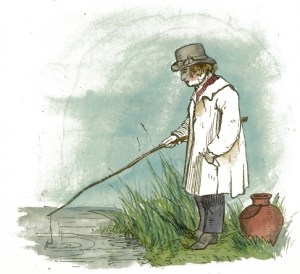
Man thoughtfully fishing with a stick

Language is essential for sustaining consciousness. Without it, we go into a coma. (Image: Reusable Art)

A vague mysticism sets in where we assume that humans are condemned to live in a world we can never properly describe or even conceptually grasp. Unless we can master something like the knowledge-obliterating Buddhist technique of direct perception, we are forever divorced from reality and therefore must live our lives in a language-induced haze of unreality, error, and arbitrary subjectivity. There exists a widespread opinion that what goes on inside our heads has little or nothing to do with what goes on around us. Solipsism, the philosophical theory that all we can be sure of is the self, gains credence.

Continue reading “Fishing Language from the Sensory Deprivation Tank”

Neo-Primitive Thinking

Progressives think in a crudely primitive way about projects that promote prosperity, but may impact the environment.

Whatever happened to the idea of progress? I do not mean “progressive,” as in ever more social spending and the inevitable national bankruptcy, ruin, and widespread poverty that follows – like the gold-plated “Club Med” European model which brought about so many national financial crises of a few years ago, or the Chavez/Maduro model responsible for the ongoing social and economic collapse in Venezuela. No, I mean the plain old-fashioned Anglo-American kind of progress.

Aerial view of Hoover Dam

Projects like the Hoover Dam, once considered “progress” are now condemned by crude environmental thinking that resembles the worldview of primitive societies. (Image: public domain)

If you are young, you may not remember, but there was a time when “progress” meant building things to make what we need more abundant and affordable. That would include structures like dams to generate loads of cheap electricity and to ensure everyone has plenty of inexpensive clean water. It would also include pipelines to provide ourselves with the affordable gasoline we need for our cars, or the inexpensive natural gas needed to heat our homes. Things like roads and bridges so we can get where we want to go and to open up new areas for the development that will continue to enhance our prosperity. We are talking about the kind of progress that makes everything more plentiful and less expensive; the kind of progress that makes our lives better, more convenient, and more prosperous; and the kind of progress that really is the only way to reduce poverty.

Continue reading “Neo-Primitive Thinking”

The Zen Man

In her Diary of Vowels, Jungian analyst Helen M. Luke describes a type of person she refers to as “the Zen man.” According to Luke, “He is … one who does everything with his whole heart, with complete commitment and devotion – or, in Jung’s words, one who lives his hypothesis to the bitter end, to the death if need be.”

Buddha Statue

It is a mistake to compare Buddhism’s wholeheartedness with Jung’s idea of authenticity. (Image: public domain.)

The concept of wholeheartedness in Zen Buddhism refers to complete sincerity and commitment. Many in the West, including Luke, have tried to equate Zen wholeheartedness with Jung’s notion of wholeness and authenticity. Jung himself may have made the comparison, as Luke seems to suggest.

Continue reading “The Zen Man”

How Philosophical Writers Think

Regular visitors to this blog know that the French philosopher and spiritual writer Antonin Sertillanges is a favourite of mine and has been a huge influence on my thinking when it comes to living a thinker’s life; his thoughts on the lifestyle, attitudes, and work habits of the serious intellectual are always worthy of careful consideration. In this post, I am going to look at some key considerations that underpin a philosophical work and link them to my own subjective approach.

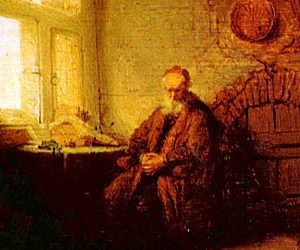
Detail from Rembrandt's Philosopher Meditating

Effective philosophical works need a suitable scale, a unique personal perspective, and a definite focus. (Image: Wikimedia)

Continue reading “How Philosophical Writers Think”

Slicing the Life of Pi

The Introduction

These are irrational times. Subjectivism (noun: the doctrine that knowledge and value are dependent on and limited by your subjective experience – WordWeb) is something I believe in myself, but the idea is being misused to justify some highly questionable moral and spiritual positions. We see this in Yann Martel’s novel, Life of Pi. Martel is a fine writer. His book is a great read, but its message is just plain foolish.

Life of Pi Cover

Can we skip thinking, ignore reality, and believe something just because we like the sound of it?

The Moral Sense

Martel ludicrously simplifies the difficult subject of the moral sense by working the popular emotional angle: “… a quickening of the moral sense, which strikes one as more important than an intellectual understanding of things; an alignment of the universe along moral lines, not intellectual ones; a realization that the founding principle of existence is what we call love.”

Continue reading “Slicing the Life of Pi”

Epiphanies and Cascading System Failures

American science fiction writer Philip K. Dick (whose work inspired “Blade Runner”) got a bit crazy as he aged. He often believed that some small incident or accidentally seen image had radically altered his mind. While Dick may have been on his way to mental instability, there is nothing wrong with the concept of a seemingly insignificant “something” causing massive changes in the mind. The unconscious mind definitely works on associative principles, which means a small change in input can bring about a huge change in outcome, just the situation Dick foresaw and both feared and felt in awe of. In Dick’s case, the fear fed a growing sense of paranoia and spawned conspiracy theories featuring him as the target. The numinous awe convinced him he was getting messages from God.

Philip K. Dick

American science fiction writer Philip K. Dick fell victim to a mental cascading system failure and mistook it for an epiphany. (Photo: Wikipedia)

Continue reading “Epiphanies and Cascading System Failures”