We Live in Baroque Times

Every age acquires a label of some kind, a word or phrase designed to capture the essence of the times. We have seen “the post-industrial society” and the “information age,” the one indicating what we have left behind, the other where we have arrived. Yet neither of these economic descriptors truly captures the irrational emotional state that now permeates, and so powerfully disturbs, the troubled Western World.

Illustration from Danse Macabre

The modern taste for shock, irrationality, the supernatural, and everything to excess remarkably resembles the earlier Baroque period. (Image: Wikimedia)

We in the West should seriously consider labelling our present era the “neo-Baroque.” In their landmark work, Theory of Literature, Weller and Warren claim that the Baroque period was in love with paradox, the oxymoron (e.g. deafening silence), and catachresis (deliberate wrong use of words), and not just in the sphere of literature, which is, after all, philosophy for its time, but at large in society as well. Today, we see the same tastes running amok in all Western societies.

Continue reading “We Live in Baroque Times”

Are You Fed Up and Longing To Be a Hermit?

One frigid January night in 2002, while living a hermit’s life in my draughty shack nestled beside a ten-thousand acre tree farm, I turned on the radio at 2:30 AM to catch the CBC Radio rebroadcast of Radio Australia’s “The Religion Report.” I am a manic-depressive and sometimes keep strange hours in order to manage my mood swings. Staying up late to deprive myself of sleep shifts me (like everyone else) away from depression.

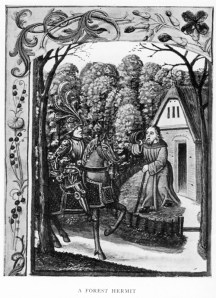
Forest Hermit and His Hut

The mindset of an anchorite can be useful in everyday life. (Image: public domain.)

On that particular gloomy night, I was delighted to hear Rowan Williams, the then Anglican Archbishop of Wales, do an interview about the ancient Christian concept of what it means to be a religious hermit or anchorite. Badly in need of some cheering up, the unusual topic seemed wonderfully appropriate!

Continue reading “Are You Fed Up and Longing To Be a Hermit?”

Disliking Yourself

Inner emptiness, the inability to tolerate being alone are symptomatic of a lack of self-knowledge, a poorly defined sense of self. Sufferers often describe the chronic condition as a feeling of loneliness. People with this problem usually have a desperate need for the regard and affection of others, said regard and affection providing the means to ward off, or at least ameliorate, painful self-dislike. Since they cannot accept themselves, they have a powerful need to forget themselves, to get out of themselves, to do something, anything, which will promote self-forgetfulness, self-oblivion. Psychologists claim that a lack of happy family life in childhood may lay the foundations for such a plight. A child unloved by its parents never learns to love itself.

Eleanor Rigby Statue in Liverpool

Like The Beatles’ “Eleanor Rigby,” you may experience self-alienation as a feeling of intense loneliness or inner emptiness. (photo: Erik Ribsskog)

Continue reading “Disliking Yourself”

Neo-Primitive Thinking

Progressives think in a crudely primitive way about projects that promote prosperity, but may impact the environment.

Whatever happened to the idea of progress? I do not mean “progressive,” as in ever more social spending and the inevitable national bankruptcy, ruin, and widespread poverty that follows – like the gold-plated “Club Med” European model which brought about so many national financial crises of a few years ago, or the Chavez/Maduro model responsible for the ongoing social and economic collapse in Venezuela. No, I mean the plain old-fashioned Anglo-American kind of progress.

Aerial view of Hoover Dam

Projects like the Hoover Dam, once considered “progress” are now condemned by crude environmental thinking that resembles the worldview of primitive societies. (Image: public domain)

If you are young, you may not remember, but there was a time when “progress” meant building things to make what we need more abundant and affordable. That would include structures like dams to generate loads of cheap electricity and to ensure everyone has plenty of inexpensive clean water. It would also include pipelines to provide ourselves with the affordable gasoline we need for our cars, or the inexpensive natural gas needed to heat our homes. Things like roads and bridges so we can get where we want to go and to open up new areas for the development that will continue to enhance our prosperity. We are talking about the kind of progress that makes everything more plentiful and less expensive; the kind of progress that makes our lives better, more convenient, and more prosperous; and the kind of progress that really is the only way to reduce poverty.

Continue reading “Neo-Primitive Thinking”

How Philosophical Writers Think

Regular visitors to this blog know that the French philosopher and spiritual writer Antonin Sertillanges is a favourite of mine and has been a huge influence on my thinking when it comes to living a thinker’s life; his thoughts on the lifestyle, attitudes, and work habits of the serious intellectual are always worthy of careful consideration. In this post, I am going to look at some key considerations that underpin a philosophical work and link them to my own subjective approach.

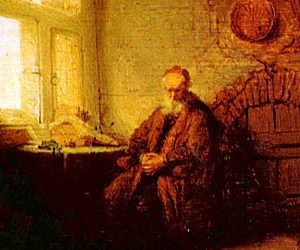
Detail from Rembrandt's Philosopher Meditating

Effective philosophical works need a suitable scale, a unique personal perspective, and a definite focus. (Image: Wikimedia)

Continue reading “How Philosophical Writers Think”

Slicing the Life of Pi

The Introduction

These are irrational times. Subjectivism (noun: the doctrine that knowledge and value are dependent on and limited by your subjective experience – WordWeb) is something I believe in myself, but the idea is being misused to justify some highly questionable moral and spiritual positions. We see this in Yann Martel’s novel, Life of Pi. Martel is a fine writer. His book is a great read, but its message is just plain foolish.

Life of Pi Cover

Can we skip thinking, ignore reality, and believe something just because we like the sound of it?

The Moral Sense

Martel ludicrously simplifies the difficult subject of the moral sense by working the popular emotional angle: “… a quickening of the moral sense, which strikes one as more important than an intellectual understanding of things; an alignment of the universe along moral lines, not intellectual ones; a realization that the founding principle of existence is what we call love.”

Continue reading “Slicing the Life of Pi”

The Cult of the Individual

French journalist and philosopher Albert Camus said, “man in the world is absurd.” Like so many recent Western philosophers, he was thinking of the individual rather than the human race as a whole. Camus felt that he (like all individuals) was alone in the world, and the world, being cold and inanimate, cared nothing for him. In return, he owed the indifferent world nothing. While he does end on a defiant note (we must stand against the uncaring world and take possession of it) this is definitely not a philosophy designed to infuse your spirit with joy.

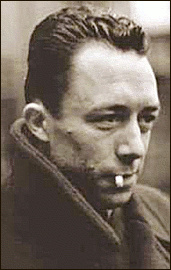
Albert Camus

Albert Camus’ emphasis on the individual left him with the feeling that “man in the world is absurd.” (Image: public domain)

Camus’ position arises from two sources: the human craving for meaning and the desire for individual immortality. In fact, he frames his entire argument from the perspective of the individual person. Nowhere does it occur to him that he might take a broader perspective, move to a higher level. When it comes to meaning and immortality, the concept of society (humans in organized groups) is not on the radar for Camus. There is only the wretched mortal individual and his pathetic lonely agony in a cruel world.

Continue reading “The Cult of the Individual”

The Virtuous Intellectual

French philosopher and spiritual writer Antonin Sertillanges has described three virtues essential for the serious intellectual. I try to live by these virtues myself, or at least, by a slightly modified version, and have expanded Sertillanges’ brief definitions to make the merits more clear.

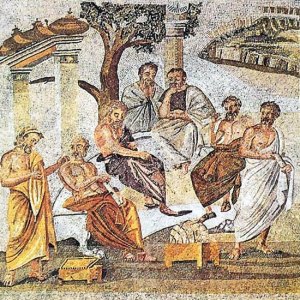
A Mosaic Depicting Plato’ and His Academy

There are three important intellectual virtues, but you can still be an intellectual without them. (Image: public domain)

THE VIRTUE OF CONSTANCY

Nothing is more useful for an intellectual than the quality of being unchanging or unwavering in purpose. This does not mean you cannot sidle off on a diversion when you stumble on something intriguing. Nor does it mean you must carve your goal in stone. It does mean you must maintain some overarching goal that has enough flexibility to allow for adjustments as the work progresses. Without such a goal, you are unlikely to accomplish much and run the risk of getting lost among the tempting possibilities encountered along the way. A goalless intellectual fritters away the concentrated effort needed to put together a complete work or viable set of new ideas.

Continue reading “The Virtuous Intellectual”

Can Illness Be A Creative Opportunity?

The ancient word “daemon” has returned to use as a way to describe the creative spirit within the unconscious. A person’s daemon is in charge of their calling or their life path and works to ensure that developments move forward as they should. It is an unnecessarily fanciful way of describing a genuine and observable phenomenon, but for the moment, we will allow the concept to stand.

Illustration from War of the Worlds - French Edition (1906)

Out of work, suffering from tuberculosis, and coughing blood, H. G. Wells saw his situation as a great opportunity. (Photo: public domain)

The daemons of psychologists Carl Jung, James Hillman, and similar others take advantage of accidents in the furtherance of their life goals. If a particular personal mishap does not suit, the daemon will wait for another. If none is forthcoming within a reasonable period, then self-sabotage may occur in order to generate the necessary life experience. The daemon must have what it needs to further the “calling” which it both guards and promotes, although this can be hard to perceive since each daemon, each calling, has its own unique requirements.

Continue reading “Can Illness Be A Creative Opportunity?”

Does Old Age Mean Nothing Left to Lose?

Jungian analyst and author, Helen M. Luke, wrote a number of volumes of insightful literary criticism and numerous philosophical essays with a strong spiritual aspect. In the collection titled simply, Old Age, she writes about growing old wisely. Her work is always worth reading. However, as she grew old herself she became something of a defeatist, and as have so many others in the West, seems to have fallen under the influence of Buddhism. She nihilistically exhorts us, as we grow old, to “let go of much that has been central even to our inner lives.” She proposes abandoning “the wisdom and grace which have come to us through the active years of our lives.”

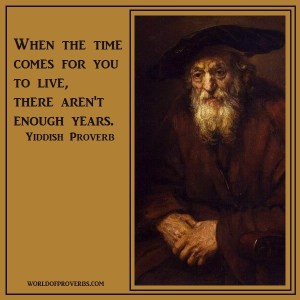
Old Man and Old Age Proverb

While much else may have fallen away, wisdom and strengthening inner resources are the just rewards of a long life. Make sure you preserve them.

Continue reading “Does Old Age Mean Nothing Left to Lose?”