The Cult of the Individual

French journalist and philosopher Albert Camus said, “man in the world is absurd.” Like so many recent Western philosophers, he was thinking of the individual rather than the human race as a whole. Camus felt that he (like all individuals) was alone in the world, and the world, being cold and inanimate, cared nothing for him. In return, he owed the indifferent world nothing. While he does end on a defiant note (we must stand against the uncaring world and take possession of it) this is definitely not a philosophy designed to infuse your spirit with joy.
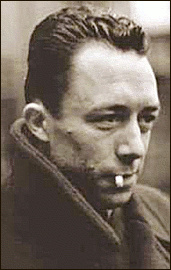
Albert Camus

Albert Camus’ emphasis on the individual left him with the feeling that “man in the world is absurd.” (Image: public domain)

Camus’ position arises from two sources: the human craving for meaning and the desire for individual immortality. In fact, he frames his entire argument from the perspective of the individual person. Nowhere does it occur to him that he might take a broader perspective, move to a higher level. When it comes to meaning and immortality, the concept of society (humans in organized groups) is not on the radar for Camus. There is only the wretched mortal individual and his pathetic lonely agony in a cruel world.

Continue reading “The Cult of the Individual”
Battling Our Inner Conflicts

One of my favourite psychology books is Karen Horney’s, Our Inner Conflicts. No one explains psychological conflicts better than this German-American psychiatrist does. Horney makes the brilliant point that both sides of an inner conflict are not wanted – a real conflict that is, not just a bad case of indecision over two equally desirable alternatives. She believes a victim of conflict gets hung up on the two opposed “trends” and is thus unable to pursue the outcome they really desire.

Karen Horney

Karen Horney explained how both sides of an inner conflict are things we do not want! (Image: public domain.)

Here is how this mechanism gets started.

The about-to-be conflicted individual represses what they truly want (for any number of reasons) and then goes looking for alternatives, all of which are, of course, less desirable than what has been pushed out of sight. The human mind being what it is, the moment we conceive one alternative its opposite immediately springs to mind. Several pairs of opposites may be generated in this way, but eventually one possibility, along with its inevitable opposite, will seem like the most probable choices.

Continue reading “Battling Our Inner Conflicts”

What Powers the Human Psyche?

Nothing happens in this world without some kind of energy to power it, to make it manifest. That being the case, what powers the human psyche where so much of what is important in this world occurs? The most obvious candidates are the powerful urges of urges of emotion and the more precise logical functions of reason. Most often, opinion divides between these two options while a minority (trying to be moderate and sophisticated) take the middle ground and say that both reason and emotion power the psyche in a sort of psychic balancing act. This, they claim, yields the proverbial well-balanced person.

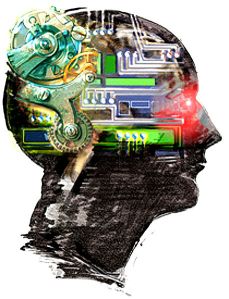
Cross-section of an electronic and mechanized brain.

Does reason or emotion rule the mental roost? Or is there another factor? (Image: public domain.)

Continue reading “What Powers the Human Psyche?”

The Virtuous Intellectual

French philosopher and spiritual writer Antonin Sertillanges has described three virtues essential for the serious intellectual. I try to live by these virtues myself, or at least, by a slightly modified version, and have expanded Sertillanges’ brief definitions to make the merits more clear.

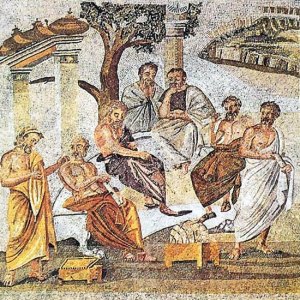
A Mosaic Depicting Plato’ and His Academy

There are three important intellectual virtues, but you can still be an intellectual without them. (Image: public domain)

THE VIRTUE OF CONSTANCY

Nothing is more useful for an intellectual than the quality of being unchanging or unwavering in purpose. This does not mean you cannot sidle off on a diversion when you stumble on something intriguing. Nor does it mean you must carve your goal in stone. It does mean you must maintain some overarching goal that has enough flexibility to allow for adjustments as the work progresses. Without such a goal, you are unlikely to accomplish much and run the risk of getting lost among the tempting possibilities encountered along the way. A goalless intellectual fritters away the concentrated effort needed to put together a complete work or viable set of new ideas.

Continue reading “The Virtuous Intellectual”

Cargo Cults of the Unconscious Mind

We have all heard of the South Seas islanders who belong to bizarre cargo cults. The cults got started shortly after WW II when the Americans pulled out of their many military bases scattered across the Pacific. It was cheaper to leave large quantities of supplies and gear behind than to transport them home so, as is so often the case with the Americans, they generously donated the materiel to the inhabitants of the islands. Having seen all this abundance arrive in airplanes, but not understanding where it came from, the less sophisticated natives decided they could get more of this cargo (and thus secure eternal peace and happiness) by simply luring passing planes from the sky. All they had to do was clear a rough runway, build a wooden plane for a decoy, and set up some homemade landing lights by making fires lined up in neat parallel rows.

Douglas C-47 Cargo Plane

Not all cargo cults have to do with South Seas islanders and US supply planes. The West has its own peculiar cargo cults. (Image: public domain)

Continue reading “Cargo Cults of the Unconscious Mind”

Can Illness Be A Creative Opportunity?

The ancient word “daemon” has returned to use as a way to describe the creative spirit within the unconscious. A person’s daemon is in charge of their calling or their life path and works to ensure that developments move forward as they should. It is an unnecessarily fanciful way of describing a genuine and observable phenomenon, but for the moment, we will allow the concept to stand.

Illustration from War of the Worlds - French Edition (1906)

Out of work, suffering from tuberculosis, and coughing blood, H. G. Wells saw his situation as a great opportunity. (Photo: public domain)

The daemons of psychologists Carl Jung, James Hillman, and similar others take advantage of accidents in the furtherance of their life goals. If a particular personal mishap does not suit, the daemon will wait for another. If none is forthcoming within a reasonable period, then self-sabotage may occur in order to generate the necessary life experience. The daemon must have what it needs to further the “calling” which it both guards and promotes, although this can be hard to perceive since each daemon, each calling, has its own unique requirements.

Continue reading “Can Illness Be A Creative Opportunity?”

Emotions Turned Art into Communication

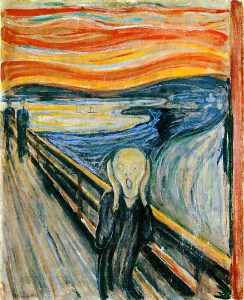
Expressionism is a style of painting, music, or drama in which the artist or writer expresses an inner emotional response rather than merely depicting an external reality. A deliberately exaggerated or altered rendition of reality allows the portrayal of subjective inner feelings. As an art movement, it was popular in Germany early in the 20th century. Edvard Munch’s familiar painting, ‘The Scream,’ was a precursor to the movement and the renowned canvas gives some idea of the technique.

The Scream. Edvard Munch's most famous painting.

Edvard Munch’s famous painting, The Scream, gives some idea of the emotional expressionist technique. (Image: public domain)

The German philosopher Johann Gottfried Herder provided expressionism with a powerful new philosophical underpinning. This was the idea that self-expression is a primal need of human beings. Moreover, unless they cripple themselves with inhibition or self-constraint, whatever a person does expresses their whole nature. A new attitude toward works of art themselves arises from the view that an artist reveals himself in what he does. Philosopher and historian Isaiah Berlin has pointed out that, prior to the advent of expressionism, works of art were valued primarily as objects. Their value had nothing to do with the artist who made them or why they had come into being. In fact, for most people today, this view of art objects still prevails. Herder believed that, since a work of art is an expression of the whole being of the artist, including his cultural identity, it must be valued within that larger frame.

Continue reading “Emotions Turned Art into Communication”

The Constant Self Is Real

When feelings such as loneliness, loss, and placelessness assail them, people often get into serious emotional trouble. It is interesting to note that, when some people experience such feelings, they do not turn inward for an explanation of their own emotions. They do not even turn to psychology or philosophy, external knowledge bases which would give them some inkling of what is happening to them and are therefore relevant to their condition. Instead, they turn to spiritual belief systems. With Christianity, the West’s traditional religion, now fallen from favour, troubled individuals feel they must look elsewhere for spiritual comfort and understanding. With increasing regularity, they turn to godless belief systems such as Buddhism and Taoism. The absence of any moralizing god and the possibility of solitary spiritual practice are powerful attractions. That is, people prefer a godless belief system with no churches or temples and no organized religious service. We might call this, “do it yourself” spirituality.

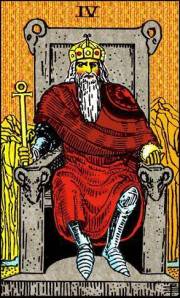
Tarot card showing the emperor on his throne

The authentic self is real, constant, and stable. Once found and accepted, it can provide a centre, still point, and anchor in life. (Image: public domain.)

Continue reading “The Constant Self Is Real”

Does Old Age Mean Nothing Left to Lose?

Jungian analyst and author, Helen M. Luke, wrote a number of volumes of insightful literary criticism and numerous philosophical essays with a strong spiritual aspect. In the collection titled simply, Old Age, she writes about growing old wisely. Her work is always worth reading. However, as she grew old herself she became something of a defeatist, and as have so many others in the West, seems to have fallen under the influence of Buddhism. She nihilistically exhorts us, as we grow old, to “let go of much that has been central even to our inner lives.” She proposes abandoning “the wisdom and grace which have come to us through the active years of our lives.”

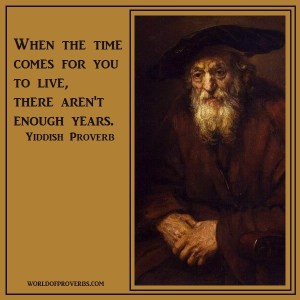
Old Man and Old Age Proverb

While much else may have fallen away, wisdom and strengthening inner resources are the just rewards of a long life. Make sure you preserve them.

Continue reading “Does Old Age Mean Nothing Left to Lose?”

Bertrand Russell’s Philosophical Loneliness

While not the most sympathetic, Ray Monk is perhaps the most thorough biographer of the English philosopher and mathematician Bertrand Russell. According to Monk, Russell felt lonely and separated. He felt trapped inside the prison walls of his self, and believed only another person could alleviate the agony of imprisonment by seeing into his soul. (For clarity, I should mention that Russell was one of those who used the word “self” to describe the conscious “I.”) This is the desire, so commonly met with, to find a profoundly understanding soul mate.

Bertand Russell

Bertrand Russell craved someone who could see into his soul and relieve his sense of loneliness and separation. (Image: public domain)

In reality, Russell was agonizingly self-alienated. As someone who stressed conscious reasoning above all else, he was partially cut off from his unconscious mind. The resulting isolation of his ego, or “self” as Russell would have it, was the source of his painful loneliness. A sound connection with the unconscious adds richness to life. A more plentiful supply of allusive symbols and subjective images would have balanced the dry logic of mathematics and the cold sterility of abstract reasoning that were the centrepieces of Russell’s world. He would have had a greater sense of meaning. In all likelihood, an improved connection with the unconscious would have enhanced his emotional life as well.

Continue reading “Bertrand Russell’s Philosophical Loneliness”