Your Worldview Will Sneak into Your Novel

The Concept of “World” in a Novel

A novel’s “world” is the general impression readers absorb from the interwoven effects of plot, characters, authorial tone, atmosphere, and setting. Writers impart this vital yet elusive quality as their own worldview inevitably pervades the work. The process is partially inadvertent and the resulting worldview may differ somewhat from the worldview purposely expressed in the work. For example, authors who write religious thrillers may or may not be religious people themselves. An unbeliever’s attitude towards the clergy may lack the sympathy of a believer. We pick up the author’s “true” worldview by sensing their way of presenting the story. We detect subtle philosophical clues such as what an author chooses to emphasize and how they go about ordering events and tying the story together.
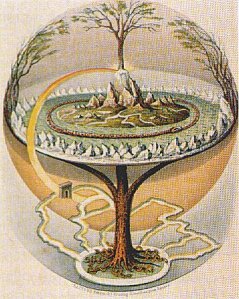
Yggdrasil by Oluf Olufsen Bagge 1847

Yggdrasil, the world tree, was the Nordic symbolic representation of the world. These days, worldview varies on an individual basis, but always has an underlying humanness shared by all. (Image: public domain)

Continue reading “Your Worldview Will Sneak into Your Novel”

Creative Individuals Are Promethean Rebels

Prometheus Bound

Prometheus stole the gods’ fire. Creative individuals steal the gods’ thunder by exercising free will. (Image: public domain.)

Resistance Is Not Futile

“It is the possibility of resistance to the needs of desire, on the one hand, and the dictates of intellect and reason, on the other, that constitutes human freedom.” The quote is from Hannah Arendt’s Willing. My own rewording of the idea goes like this: Human will is able to steer a course between the powerful urges of instinct on the one hand and the incessant petitioning of reason on the other. It reminds me of the old Greek legend of Scylla and Charybdis. Will is like a ship traversing the narrow strait with the devouring monster of instinct on one side and the drowning whirlpool of nagging reason on the other.

Continue reading “Creative Individuals Are Promethean Rebels”

Writers Are Often Early Birds or Night Owls

At what time of the day do you prefer to write? Do you have a choice as to when you do your writing or are you limited by a day job and other important responsibilities? Constraints can be a problem since writers often have unusually strong preferences for when they like to get the work done. In fact, it may go beyond being just a preference. There is good evidence from creativity research that people function best at certain times of the day, and what time that is varies on an individual basis.

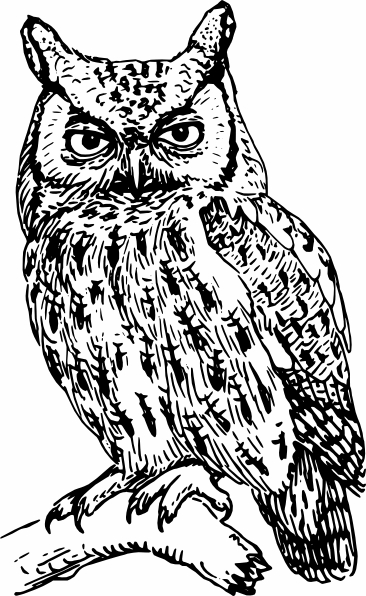
Owls are the quintessential image for the night person

Writers can use hours of the day when little is happening. The need for a more certain income may leave them no choice. (Image: public domain.)

As for preference, there are two main camps: the morning crowd and the late evening / nighttime set. There are even philosophical and psychological arguments supporting the two strategies.

Continue reading “Writers Are Often Early Birds or Night Owls”

Affirmation or Negation – Two Ways to Approach Life

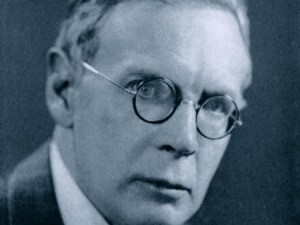
Charles Williams

Inklings member and author Charles Williams surprisingly demonstrated that either affirmation or negation of life can be a legitimate path to personal fulfillment. (Image: public domain.)

As is now widely known, C. S. Lewis (The Chronicles of Narnia) was a member of a writer’s circle known as the Inklings. J. R. R. Tolkien also belonged to this remarkably talented group. A lesser-known member of the circle was the poet, novelist, and literary critic Charles Williams who, like Lewis, wrote a number of books about his deeply held religious beliefs.

The occult also fascinated Williams. He went on creatively to merge religion with the occult in a series of unusual novels that he referred to as “metaphysical thrillers.” (T. S. Eliot used the word “supernatural” when writing about them.) They read like speculative fiction yet manage to include elements such as the Holy Grail, tarot cards, King Solomon’s Stone, Platonic archetypes, doppelgangers, and a succubus all surrounded by insights into the eternal struggle between good and evil and the effects (both good and bad) of possessing great power. Williams is rare in assuming that great power can sanctify. When was the last time you saw a film or read a book where that was the case?

Continue reading “Affirmation or Negation – Two Ways to Approach Life”

Creative People Explore “Hidden Realities”

For centuries, philosophers have made mention of a “hidden reality” and then speculated as to its nature and how one might dispel illusion and bring what is hidden within sight. Those given to metaphysical speculation posit another world reached by passing through a portal. We have all seen the movies and television series inspired by the old tales of magical caves or fairy rings that, once entered, transport one to another place not of this Earth. Spiritual types speak of supernatural beings inhabiting spirit worlds “beyond” our normal ken. The belief gave rise to some of the world’s largest religions.

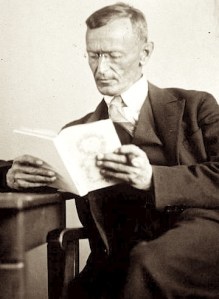
Hermann Hesse reading a book

Hermann Hesse used simple doors to symbolize the entrance to hidden realities in his controversial novel, Steppenwolf. (Photo: Wikimedia)

The idea of a hidden reality or an unseen place where spirits dwell is so prevalent in human cultures that one must assume it has some basis in human psychology.

Continue reading “Creative People Explore “Hidden Realities””

What Is Your Life’s Theme?

What is the theme of your life? Everybody has at least one; most of us have a number of them, each taking a turn in the spotlight, and then fading for a time. However, it may not have occurred to you to see things in that way. Writers consciously make use of themes in their works so they are accustomed to employing them as an important aspect of writing fiction. Not surprisingly, many great writers use the themes from their own lives as the themes in their books and stories. To put it another way, writers tend to write about what deeply interests or preoccupies them. Readers tend – often unconsciously – to choose writers and books that deal with their own themes.

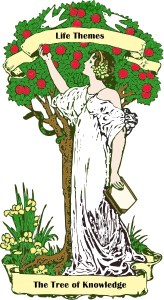
Wisdom Harvests the Tree of Knowledge

Many great writers have used the themes from their own lives as the themes in their books and stories. Do you know what your themes are? (Image: public domain.)

Writers embody the theme or “idea” behind any particular story in the work’s characters, places, and events. They usually settle on a strategy during the conception and design stage of the writing process. You might say that the basic theme or idea of a novel has something to do with what the author “loves well.” In the course of the story, authors contrast what they love with what they reject, thus clearly presenting the theme, and their position on it, to the reader.

Continue reading “What Is Your Life’s Theme?”

Only the Strong Can Be Solitary Thinkers

Thinking requires solitude. It is a simple fact that it is impossible to think – deeply at any rate – while interacting with others. Add another mind and right away, the path ahead becomes tortuous. Human minds tend to diverge. Opinions seem always to vary. Except when they are trying hard to get along, minds agree on precious little. Inevitably, discussing any topic will lead to disagreement and the taking up of positions. This can be interesting and enlightening, but conversation definitely will not take one where one would go on one’s own. To think anything through to one’s own fully developed conclusions, one needs to be alone.

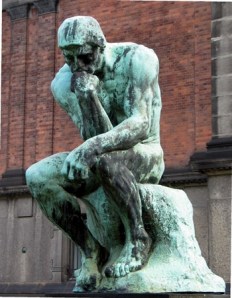
The Thinker by Auguste Rodin

Rodin’s famous statue of the thinker shows him alone. Sustained solitude is a requisite for insightful thinking. (Image: public domain.)

We are walking a lightly trod, yet millennia-old path here. The thinking tradition is illustrious and those given to habitual thinking have left us a fine legacy of insights into the nature of solitude.

Continue reading “Only the Strong Can Be Solitary Thinkers”

Lifestyles of Writers and Other Creative People

High-level creativity takes time, lots of it. It also needs peace and quiet. To secure the requisite time and tranquility, creators of all kinds have traditionally turned away from mainstream lifestyles and embraced less conventional ways of life. The taste among intelligent middle-class English writers for living quietly – and inexpensively – in the unsophisticated countryside is the stuff of literary legend. The goal is always the same: liberate as much time as possible for the creative work while ensuring congenial conditions for getting it done.

George Orwell's Country Retreat in the Hebrides

Cheap rural retreats such as George Orwell’s remote home in the Scottish Hebrides are a staple in the lives of creative people. (Image: public domain.)

Continue reading “Lifestyles of Writers and Other Creative People”

Popular Creativity Theories

We Have Not Always Been “Creative”

The Greeks and Romans ascribed the source of what we call creativity to a “genius” (Roman) or “daemon” (Greek) linked to the gods. The concept of creativity as we know it did not yet exist and the ancients regarded being “inventive” as an external process. The modern concept of creativity appeared during the Renaissance when, for the first time, Europeans saw creativity not as a gift from a god, but as arising from the abilities of “great men.” However, the shift from divine origins to mortal was gradual and did not become widespread until the Enlightenment.

Graham Wallas, 1920s

English social psychologist Graham Wallas gave us the famous five-stage theory of the creative process. (Image: public domain.)

English mathematician and philosopher Alfred North Whitehead coined the term creativity in 1927 while delivering the Gifford Lectures at the University of Edinburgh. Almost immediately, it became the word of choice in literature, the arts, and science. In fact, the term went into wide use so quickly, we have forgotten its recent origins in the twentieth century.

Continue reading “Popular Creativity Theories”

Make Bliss Your Creative Compass

We all know that enjoying the work we must do to earn a living makes life more pleasant. Tastes vary, naturally, but most people regard creative work of any kind as a highly desirable occupation. Many would gladly trade their “day job” for the chance to participate. We see one aspect of this yearning in the explosion of self-published authors currently flooding a startled world with oceans of novels and short stories. However, the idea of doing what we love applies at another level. Within the world of creative endeavour itself, it is especially important to do what we find most congenial.

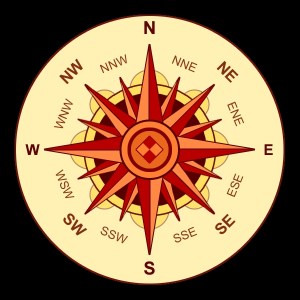
Decorative Compass Rose

Certain shades of feeling are associated with your authentic will and can be used as a reliable inner guide or compass. (Image: public domain.)

Continue reading “Make Bliss Your Creative Compass”