The Importance of Being Superior

Austrian doctor and pioneering psychotherapist Alfred Adler made the inferiority complex central to his thinking. He believed that, “When the individual does not find a proper concrete goal of superiority, an inferiority complex results. The inferiority complex leads to a desire for escape and this desire for escape is expressed in a superiority complex, which is nothing more than a goal on the useless and vain side of life offering the satisfaction of false success.”

Portrait photo of Alfred Adler

Pioneering psychotherapist Alfred Adler recognized our innate need to feel superior in some legitimate way. (Photo: public domain)

Adler’s “concrete goal of superiority” is a shorthand way of describing the authentic struggle for self-discovery and self-realization, which always plays out as a determined quest for various life goals. Failure to pursue self-realization (what life is all about) results in self-alienation. I can personally testify that this mental state does lead inevitably to feelings of gross inadequacy and inferiority. These negative feelings in turn prompt the formation of a monstrous vain and supercilious false persona, Adler’s “goal on the useless and vain side of life offering the satisfaction of false success.” Builders of false personas chase ego-enhancing goals with little in the way of usefulness, substance, or relevance to their authentic selves. Empty flash and glitter triumph over meaningfulness and emotional gratification.

Continue reading “The Importance of Being Superior”

Religious Conversion Can Block Self-Discovery

An Introduction

In my earlier post, “Outrunning the Hound of Heaven,” I described how repressed material in the unconscious mind might drive the religious impulse. I used (among others) the English writer C. S. Lewis as an example. Today I want to present the idea that religious conversion may be an evasion, a way of avoiding the psychologically rigorous journey of self-discovery. I have drawn the material from my diary. To show what an individuation diary can look like, I have left the entry in its original form and appended a more recent commentary to elaborate on the ideas.

Painting depicting the conversion of St. Paul.

Sudden religious conversion may be a way of avoiding the much more rigorous process of self-discovery and self-acceptance. (Image: Wikipedia)

Continue reading “Religious Conversion Can Block Self-Discovery”

How Mood Inspires Creative People

One of the most striking characteristics of the creative individual is their sensitivity to, and fondness for, particular feeling tones or subtle moods. Artists of all kinds strive to capture their favourite mood (or moods) in their work. The desire to accomplish this combined act of self-gratification and sharing is often a major motivating factor in why the artist chose to work in the arts. However, the preoccupation with mood can infiltrate all aspects of a creator’s life. The taste for a special mood often extends to the creator’s work habits. They not only want to produce the mood in their work, they must inhabit the mood while working. Many artists are so sensitive to feeling tone, so dependent on a particular subtle mood in order to access their creativity, that they quite literally cannot work should the needed feeling tone be absent.

Daphne du Maurier rowing near her old house at Ferryside

Mood (or atmosphere) and a sense of place are intimately related. Writers who have a strong sense of place prefer to work in specific locations. (Image: public domain.)

Continue reading “How Mood Inspires Creative People”

Very Inspiring Blogger Award

Thank You for the Nomination

I want to thank Lucinda Elliot, talented Gothic novelist and all-around good person, for the nomination.

Very Inspiring Blogger Award Icon
The VIB Badge

Seven Facts About Me

I’m trying to lose some weight and cannot explain why the following facts came to mind.

  1. My favourite fast food meal is a chicken burger with tomato lettuce and mayo, and French-fries on the side.
  2. I am a dedicated tea lover and only drink coffee when dining out (and only then because the tea in Canadian restaurants is appalling).
  3. I love Coke Zero. Great taste that fools the body into thinking it just got something all sugary and energizing.
  4. Chocolate-covered coconut bars call out to me from store shelves (in both official languages, naturally).
  5. A bowl of crunchy Bran Buds is part of my breakfast routine.
  6. The pheromones emitted by donuts have a profound effect upon my mind making me forget all about dieting and causing me to see myself in the mirror as being slimmer than I thought.
  7. I am remarkably good with numbers – except when it comes to adding up calorie counts, which I always (strangely) seem to underestimate. Not that I’m dishonest or anything! 🙂

My Own Nominees for the Award

Try these wonderful blogs!

  1. Taste for Adventure – domestic, intelligent, and uplifting
  2. A Poem for Every Day – classic poems with a penetrating and inspiring gloss
  3. Another Wandering Soul – high calibre contemporary poetry
  4. River of the Heart – lovely poetry with an Asian flavour
  5. Wandering Gypsy Spirit – a philosophical trucker!

The Rules of the Award

1. Thank and link back to the blogger who nominated you.

2. Add the award image to the top of your post.

3. Share seven facts about yourself.

4. Nominate fifteen other blogs (with links) and inform them about it.

(My advice: If you find fifteen a bit daunting, nominate what you feel comfortable with. There is no need to be rigid. You can add more later if you want.)

Simone de Beauvoir on Life’s Possibilities

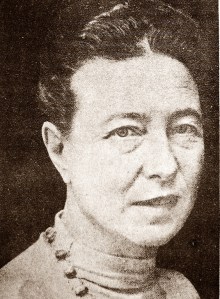
Simone de Beauvoir believed that, “The programme laid down in our childhood allows us to do, know, and love only a limited number of things; when the programme is fulfilled and when we have come to the end of our possibilities, then death is accepted with indifference or even as a merciful release – it delivers us from that extreme boredom that the ancients called satietas vitae.” The notion that our childhood defines us is sound. Our genes (character, behaviour) interact with our environment, we form a sense of how the world works, and we build a set of values. The development of this unique set of emotionally important ideas lays down the foundation of what will or will not motivate us as adults.

Simone de Beauvoir at 60

Simone de Beauvoir thought our lives are programmed in childhood with a limited set of possibilities. (Photo: Wikipedia)

Continue reading “Simone de Beauvoir on Life’s Possibilities”

Intellectual Alchemist at Work

From time to time, people ask me where I find so many and such varied post ideas. I always answer that I have been a steady reader for most of my life, and since 1990, I have had the habit of writing down my thoughts about whatever it is that I am reading. I also copy out a few quotes now and then. Over the years, those thoughts and quotes have accumulated in paper diaries, journals, notebooks, as well as their digital counterparts. Taken as a whole, they form a loosely structured representation of an ongoing attempt to understand the world around me and my own way of relating to it.

Old Computer Work Station

Working out a thorough understanding of my writing had the alchemical effect of illuminating and solidifying my entire worldview. (photo: Pdphoto)

Continue reading “Intellectual Alchemist at Work”

Beware Excessive Conceptualization

Conceptualization is a skill. The process involves working out an idea or explanation and formulating it mentally. Everyone can and does conceptualize, but like all skills, some people are better at it than others. Speed matters for many of those who consider themselves intelligent. They demonstrate their erudition and big IQ numbers – and impress others – with their ability to come up with swift conceptualizations of just about anything that crosses their path. Or so they think. In reality, we are all familiar with the person who can snap out ideas and explanations that sound plausible at the time, but which soon prove incomplete, inadequate, or just plain wrong.

Old fashioned alarm clock with a question mark on its face.

Solid conceptualization (putting the pieces together) needs time and all of the mind’s resources. The language portion of thinking must be supplemented by association, intuition, etc. (image: pixabay.com)

Continue reading “Beware Excessive Conceptualization”

Your Easy Life May Be Depressing

Depression is becoming a pandemic in the West. Perhaps surprisingly, hardship and want are not always – or even often – the source of our misery. The problem is more likely to stem from our comfortable standard of living and secure social safety net. Having it easy makes us passive and complacent – and that leaves us vulnerable to mood disorders such as depression and anxiety. Looking at some famous examples of the more chronic forms of depression will illuminate the modern experience.

Winston Churchill War Poster

Winston Churchill often battled depression calling the dark mood his “black dog.” (Photo: Wikimedia)

Depression often assailed Winston Churchill who referred to the wretched emotional state as his “black dog.” Like a loyal hound, depression has a habit of following the sufferer around. Rather than Churchill’s black dog, I use the image of a black pit when contemplating my own troubles with depression. To remain free of this gloomy curse requires constant clawing at the sloping lip of the abyss. Even a moment’s lapse in the desperate struggle results in a nasty tumble into despair, from whence it can be difficult to regain the precarious, yet greatly desired, perch on the edge. Depressive types live their whole lives in this manner. (Manic-depressives such as me get some respite during manic episodes.)

Continue reading “Your Easy Life May Be Depressing”

The Intrinsic Rewards of Mental Activity

I once saw a short film about the famous experiment where research scientists gave brushes, paint, and large sheets of paper to a number of chimpanzees, and then left them to their own devices. Soon, the chimps became so engrossed in daubing colour on the paper that they neglected their usual mating and eating habits. In a sense, they had become crude abstract artists! The important thing to note is that, while mating and eating are necessary for survival, daubing paint is not.

Mind Related Activities

Mind related activities can be so absorbing we neglect vital functions such as eating. (Photos: public domain)

The chimps were demonstrating that mind-related activity is so powerfully rewarding it can overpower even such basic life-sustaining drives as hunger and lust. If the effect is so strong in chimpanzees, we can easily see why human creators, with their more-powerful minds, behave the way they do. Here is the doorway that humans have walked through as we evolved beyond being just animals. Once our intelligence reached a certain point, mind became the primary driving force in our evolutionary development. Importantly, this is true not only because we became better at hunting and gathering, but also because mind is useful for much more than sharpening our survival skills.

Continue reading “The Intrinsic Rewards of Mental Activity”

We Need New Explanations of Reality

Every culture has its own way of accounting for reality. These explanations are necessary to enable the culture as a whole, and the individuals within it, to act and to justify those actions. We cannot come to grips with anything until we have some way of understanding and explaining what we are dealing with.

Passing of the Parliament Bill, 1911

Legislation enforces the ideology of those who elected the government, but may quash the ideology of those who voted another way. (Photo: Wikimedia)

Unfortunately, there is a huge problem here. The scheme works best if our explanation of reality is sound. In some areas, we may indeed have adequate accounts of reality (e.g. engineering), but human knowledge is limited, and in many more cases (e.g. medicine), our explanations do not coincide with actuality. In these situations, we must act within inadequate frameworks. So tenuous is our conceptual grasp on reality that sometimes we are aware of the damaging shortcomings of our explanations while at other times we remain in the dark.

Continue reading “We Need New Explanations of Reality”