The Morality of Robert Louis Stevenson

We revere Robert Louis Stevenson for his adventure novels, but he was not a genre writer in the modern sense of that term. While Black Arrow, Kidnapped, The Master of Ballantrae, and Treasure Island may seem like straightforward romantic picaresque yarns, Stevenson was always deeply concerned with the moral aspects of his story. Among his fiction, the famous novella, The Strange Case of Dr. Jekyll and Mr. Hyde most vividly reveals his other side. The story deals with Stevenson’s understanding of the subconscious mind and the idea that good and evil can reside in the same person. Issues of morality so vexed Stevenson that he called ethics his “veiled mistress.”

Portrait of Robert Louis Stevenson

Questions of morality so concerned Stevenson that he called ethics his “veiled mistress.” All of his works carry his moral values. (Image: Wikimedia)

He may have acquired a theoretical concern with morality from his fiercely Calvinist nanny, but ethical concerns literally overwhelmed him when his artistic ambitions prompted a serious clash with his conventional and practical father. Unable to sway his obstinate parent, Stevenson had to justify to himself his decision to pursue art rather than a more realistic means of earning a living.

Continue reading “The Morality of Robert Louis Stevenson”

Death Dreams and Synchronicity Oracles

Over the course of my life, there have been a number of nights where I have dreamt of my own death. Psychologists claim that dreaming of your own demise is a sign that you are about to change. I believe this is at least partly true, but might argue for serious intent rather than actuality. The story I am about to recount occurred during a period when I was recovering from a nervous breakdown and in the midst of learning that I was a type one manic-depressive. The dream did precede the abrupt cessation of mystical behaviour that had tormented me for many years. However, the change did not stick.

If you know what you are doung, gazing into crystal balls or consulting oracles can help keep you sane.

It can be a rough ride, but gazing into crystal balls or consulting oracles will allow you to dialogue with your unconscious mind. (Image: public domain.)

In the dream, I died a sudden death in a train wreck when the locomotive engineer took a curve too swiftly, toppling the train from its tracks into a forty- or fifty-foot-deep ravine. Death came on impact with the ground below. Just before the fatal accident, I remember leaning from a coach window and seeing, not far ahead, the engineer doing the same at an opening in the diesel engine’s cab. He did not seem to be paying much attention to his driving duties, a reflection, I am sure, of my own shocking self-neglect and depressed indifference to my fate at that time.

Continue reading “Death Dreams and Synchronicity Oracles”

Do You Live in the Past, the Future, or the Eternal Now?

We humans have various ways of orienting ourselves in time. Some people seem to live in the past while others are oriented towards the future. Then we have the “live in the moment” types who believe we should look neither backward nor forward but concentrate only on the here and now. Because prestigious philosophies such as Buddhism promote this “being here” attitude as a form of great wisdom, the latter group often see themselves as uniquely enlightened.

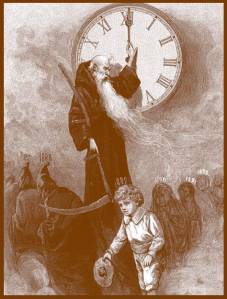
Etching of Father Time and Marchers

Father Time may relentlessly march on, but people relate to time in different ways. (public domain image)

People of all kinds and ages fall into each of the orientations, but there are some groups where folks are more likely to have one preference or another. The elderly are most likely to spend a lot of time thinking about the past. They love to look back on their long lives and fondly remember the good times or shed a tear over some lasting sorrow. Reminiscing at length with anyone who will listen is a favoured pastime. You know, chatting about “the good old days.”

Continue reading “Do You Live in the Past, the Future, or the Eternal Now?”

Teachers Are Too Big for Their Britches

I am a conservative, and like many people on the right, I have a problem with the leftist propensity for taking everything over. Leftists are against boundaries for the simple reason that they love to overstep them and meddle where they have no business getting involved. A case in point: In a recent local dispute between teachers and parents, a school spokesperson casually claimed that teachers were “co-parents” to the children who attended school. He seemed blissfully unaware that the courts have consistently recognized the primacy of parental authority in the rearing and education of children. Teachers were startled and offended by the public outrage that followed the spokesperson’s remark.

Teacher in Classroom with Young Students

Teachers have become toxically self-important at the expense of their hapless pupils. (image: clipartpal.com)

Continue reading “Teachers Are Too Big for Their Britches”

What Socrates Meant by the Examined Life

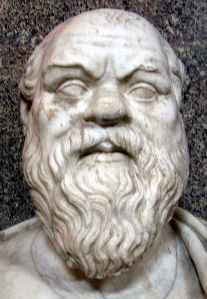
When Socrates said, “the unexamined life is not worth living” he was not recommending a life spent in endless naval-gazing, the practice of complacent self-absorption. He meant something far more rigorous. Pertaining to our day to day lives, he was telling us that philosophy is a lifelong dedication to accurate analysis and sound critical thinking about what life is and all that it means. Regarding our inner lives, we interpret his words as a call to honest introspection and an indication of the rich rewards that flow from the practice.

The Socrates Bust in the Vatican

When Socrates said, “the unexamined life is not worth living” he was challenging us to a lifetime of rigorous introspection. (Photo: Wikimedia)

This raises an important question. What is the difference between introspection and self-absorption?

Rumination as a (Possibly Bad) Habit

I am an introvert. Like all introverts, rumination is a way of life for me. Across many years, I was a conscious believer in the act of rumination, which I will define as the fine art of sitting and doing nothing while letting the mind idly wander or perhaps ponder, often somewhat obsessively, some event of the day. What I randomly mulled over might include an anxiety-inducing blunder I had made, something someone had said that seemed to have important overtones, or more happily, my creative writing or a new philosophical idea.

Continue reading “What Socrates Meant by the Examined Life”

Turn Your Anxiety into an Asset

A great deal of confusion surrounds the emotion we call anxiety. The feeling is unpleasant and makes us want to avoid whatever has aroused it, but we all know there are times (like going to the dentist) when we have to press on regardless. Few of us would ever think to describe anxiety as an asset. Yet life coach and holistic psychotherapist Robert Gerzon, author of Finding Serenity in the Age of Anxiety, actually believes anxiety can be extremely useful. In fact, he claims that “follow your anxiety” is as good a dictum as Joseph Campbell’s “follow your bliss”! He sincerely holds the view that anxiety will take us to the same destination as our bliss, a position predicated upon the idea that the pursuit of bliss will inevitably lead us into anxiety-inducing situations that we must face and overcome in order to achieve the bliss we seek.

Man Getting Anxious over His Finances

Contrary to what you might expect, anxiety can be a very useful feeling. (Photo: Public Domain Photos)

Continue reading “Turn Your Anxiety into an Asset”

Debunking the Butterfly Effect

These days we are all familiar with the concept of the “butterfly effect.” The usual formulation goes something like this: when a butterfly flaps its wings in one part of the world (often the Amazon jungle) it can cause a hurricane in another part of the world. The colossal disparity in magnitude between cause and effect embodied in the idea has fired the collective imagination around the globe.

Butterflies surround a glowing ball of energy

At the level of our lives, the famous butterfly effect is largely an urban myth. (Image: Thomas Cotterill)

The butterfly effect was “discovered” in 1961 by MIT meteorologist Edward Lorenz. He was working at the time as an assistant professor in MIT’s department of meteorology where one of his projects involved an early computer program designed to simulate weather. As so often happens in science, his discovery was accidental. Looking to save some input time, he rounded one of a dozen numbers representing atmospheric conditions from .506127 down to .506. To his amazement, the tiny reduction utterly transformed his long-term forecast. Lorenz wrote about the experience in a 1972 paper titled, “Predictability: Does the Flap of a Butterfly’s Wings in Brazil Set Off a Tornado in Texas?” The title was imaginative, intriguing, and provocative. A completely new idea was born. Vast opportunities for exciting scientific speculation suddenly sprang into being.

Continue reading “Debunking the Butterfly Effect”

Gnosticism Is Freelance Religion

Gnosticism is the practice of spiritual inquiry independent of established religious dogma. The term derives from the root, Gnosis, which refers to intuitive knowledge of spiritual truths or mysteries as originally possessed by ancient Gnostics. An essential aspect of Gnosticism is the confirmation of spiritual truths through reflection and personal experience. We might think of it as a form of “freelance religion.” Coming from actual experience, both inner and outer, the knowledge is subjective and varies from one individual to the next, a situation quite different from the abstract knowledge of learned dogma. This is why mainstream Christian churches regard Gnosticism as heresy.

Angel carrying a glowing bowl through the heavens

Gnostics practice a kind of “freelance religion.” They shun dogma and seek confirmation of spiritual truths through intuition and personal experience. (photo: public domain)

Continue reading “Gnosticism Is Freelance Religion”

The Glorious Psychology of Blogging

As a blogger, I have begun to notice that one of life’s little lessons keeps popping up in the books I am reading, a lesson that seems relevant to the way I perceive my current internet activities. It is an incredibly obvious lesson, and it seems odd to me that I have never fully comprehended this bit of wisdom before; but I suppose we never really notice anything until we are ready for the message it has to impart. The lesson is this: Revealing personal things about ourselves to others is risky because it gives power to those who now enjoy our intimacy. Not everyone in this world is well intentioned, and those who are benign in intent are very often utterly misguided in their interpretations, beliefs, and actions. The benign are thus just as likely to do us in as the malignant types!

Viking Raiders Coming Ashore

Like those shaggy sword wielding vikings of old, today’s bloggers are willing to risk life and limb to achieve immortality through glory and renown. (Photo: US History Images)

Continue reading “The Glorious Psychology of Blogging”

Simone de Beauvoir on Death

Like all those who place the ego’s false persona before all else, Simone De Beauvoir struggled mightily with the reality of death. She writes of “the scandal of finiteness,” referring to our inescapable mortality. When you insist on emphasizing your separateness and see yourself as merely an isolated conscious ego, it becomes inevitable that fear of the permanent extinction of consciousness — occasioned by physical death — will threaten your peace of mind. Death can become something of a preoccupation.

Sartre and de Beauvoir at Balzac Memorial

Simone de Beauvoir and Jean Paul Sartre wanted more from life than it could give. (Photo: Wikipedia)

The real scandal here is de Beauvoir’s way of ignoring the bigger picture — the immortality of the human race, which transcends individual mortality. Unfortunately, for those locked into believing they are merely a self-made false persona, only the individual counts. They never look beyond the boundaries of self-absorption and never seem to learn that such selfishness comes at a terrible price. Placing too much emphasis on maintaining a false image is a massive source of anxiety. The chronic angst generated by the necessity of maintaining and defending an idealized false persona is confused with fear of death and labelled existential angst. However, it is the dread of humiliation and exposure as a fraud that really drives this kind of continuing anxiety. The more-immediate fear is the death of the false persona.

Continue reading “Simone de Beauvoir on Death”