What Is Your Life’s Theme?

What is the theme of your life? Everybody has at least one; most of us have a number of them, each taking a turn in the spotlight, and then fading for a time. However, it may not have occurred to you to see things in that way. Writers consciously make use of themes in their works so they are accustomed to employing them as an important aspect of writing fiction. Not surprisingly, many great writers use the themes from their own lives as the themes in their books and stories. To put it another way, writers tend to write about what deeply interests or preoccupies them. Readers tend – often unconsciously – to choose writers and books that deal with their own themes.
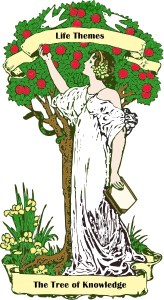
Wisdom Harvests the Tree of Knowledge

Many great writers have used the themes from their own lives as the themes in their books and stories. Do you know what your themes are? (Image: public domain.)

Writers embody the theme or “idea” behind any particular story in the work’s characters, places, and events. They usually settle on a strategy during the conception and design stage of the writing process. You might say that the basic theme or idea of a novel has something to do with what the author “loves well.” In the course of the story, authors contrast what they love with what they reject, thus clearly presenting the theme, and their position on it, to the reader.

Continue reading “What Is Your Life’s Theme?”

Lifestyles of Writers and Other Creative People

High-level creativity takes time, lots of it. It also needs peace and quiet. To secure the requisite time and tranquility, creators of all kinds have traditionally turned away from mainstream lifestyles and embraced less conventional ways of life. The taste among intelligent middle-class English writers for living quietly – and inexpensively – in the unsophisticated countryside is the stuff of literary legend. The goal is always the same: liberate as much time as possible for the creative work while ensuring congenial conditions for getting it done.

George Orwell's Country Retreat in the Hebrides

Cheap rural retreats such as George Orwell’s remote home in the Scottish Hebrides are a staple in the lives of creative people. (Image: public domain.)

Continue reading “Lifestyles of Writers and Other Creative People”

Popular Creativity Theories

We Have Not Always Been “Creative”

The Greeks and Romans ascribed the source of what we call creativity to a “genius” (Roman) or “daemon” (Greek) linked to the gods. The concept of creativity as we know it did not yet exist and the ancients regarded being “inventive” as an external process. The modern concept of creativity appeared during the Renaissance when, for the first time, Europeans saw creativity not as a gift from a god, but as arising from the abilities of “great men.” However, the shift from divine origins to mortal was gradual and did not become widespread until the Enlightenment.

Graham Wallas, 1920s

English social psychologist Graham Wallas gave us the famous five-stage theory of the creative process. (Image: public domain.)

English mathematician and philosopher Alfred North Whitehead coined the term creativity in 1927 while delivering the Gifford Lectures at the University of Edinburgh. Almost immediately, it became the word of choice in literature, the arts, and science. In fact, the term went into wide use so quickly, we have forgotten its recent origins in the twentieth century.

Continue reading “Popular Creativity Theories”

Make Bliss Your Creative Compass

We all know that enjoying the work we must do to earn a living makes life more pleasant. Tastes vary, naturally, but most people regard creative work of any kind as a highly desirable occupation. Many would gladly trade their “day job” for the chance to participate. We see one aspect of this yearning in the explosion of self-published authors currently flooding a startled world with oceans of novels and short stories. However, the idea of doing what we love applies at another level. Within the world of creative endeavour itself, it is especially important to do what we find most congenial.

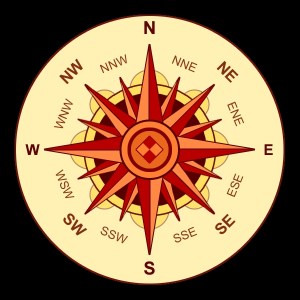
Decorative Compass Rose

Certain shades of feeling are associated with your authentic will and can be used as a reliable inner guide or compass. (Image: public domain.)

Continue reading “Make Bliss Your Creative Compass”

Being Creative with Associative Thinking

The Unconscious Observes and Comments

In earlier posts, I have written about synergistic thinking, the deliberate combining of logical (linear) and associative (non-linear) thinking. Logic is a product of the conscious mind and as such it is a thinking tool we all, with varying degrees of skill, deliberately employ. Associative thinking is how the unconscious works and can be both hard to understand and elusive in its actual – often powerful – workings. As a result, in the last few decades, a great deal of confusing superstition has gathered around the unconscious. Here is a gem from page 39 of Susan Shaughnessy’s excellent book about writing, Walking on Alligators: “The only thing we know for sure about the unconscious is that it isn’t like us. It is different from the conscious mind. It looks through our eyes, but it sees differently. It uses other rules to organize what it sees. And then it passes along its conclusions in a tantalizingly inexplicit way.”

Side View of the Brain

The unconscious mind produces an associative running commentary on our thoughts and surroundings. (Image: public domain.)

Continue reading “Being Creative with Associative Thinking”

Synergize Your Creativity with Concurrent Projects

Creativity research has a lot to say about the work habits of creative people. Let us look at the issue of working on one thing at a time versus having a number of projects going all at once. What approach do you take with your creative process? Are you among those who single-mindedly work on just one project and carefully avoid being “sidetracked” by something else? Or do you happily juggle several projects at once, switching back and forth among them as you see fit or the mood takes you?

Repeating mirror images of a woman

Creators often have several intuitively-related projects in progress at the same time and exploit the situation to synergize their creative powers with constant cross-fertilization. (Image: public domain)

The Power of Monomania

It can be tempting to insist on working with just one project at a time, starting it, and then continuing with it until it is completed. The idea is simple, straightforward, and produces finished work faster than any other technique. If you can keep going, that is. It may surprise you to learn that many creators are unable to do this. At some point, for any number of reasons, they run into difficulties that prevent them from finishing what they have started. Sometimes they abandon the project and start another – hopefully more easily completed – work. A small number cease working altogether and go through a period of renewed gestation or learning before resuming the interrupted project. Among authors, writer’s block is a frustrating form of this poorly understood process. In the situations with the best outcome, the creator will set the stalled work aside and begin with something else, something new, yet thematically related to what they had previously been doing.

Continue reading “Synergize Your Creativity with Concurrent Projects”

Are Creative People Less Sane?

Are creative people less or more sane than ordinary people? Creative types are unusually sensitive to the nuances in tone of voice, body language, innuendo, and so forth. They notice more than does the average person; they are perceptive. Regrettably, this ability has a drawback in that it means creators are more vulnerable. Already at risk simply because they are who they are, creators often have a hard life, which, being sensitive, they feel keenly. If their work does not sell, they may suffer poverty. If it challenges accepted views, it may attract enough opprobrium to diminish their self-confidence and dislodge their sometimes-precarious self-esteem. For these reasons, a creator may develop a set of psychological difficulties that resemble insanity. Yet in spite of this, creators retain their special ability with nuance. They remain better equipped to test reality than more ordinary types who, at least on the surface, appear much saner. That sensitivity to nuance, to subtle differences confers upon the creator a remarkable ability to see what others overlook. Those who see more understand more.

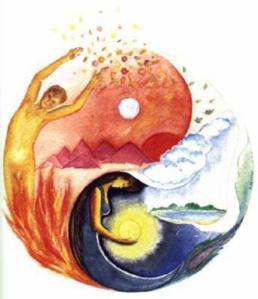
Man Woman Yin Yang Symbol

Creative people tolerate awareness of polarities and contradictions rather than trying to bury one side or the other. This can make them seem unpredictable. (Image: public domain.)

Continue reading “Are Creative People Less Sane?”

How to Ensure You Finish Your Writing Project

One of the most common mistakes made by inexperienced creators is putting too much material in one work. No one is immune to this problem. Later in life, Beethoven himself ruefully remarked that his Symphony No. 1 had enough musical ideas crammed into it to make several symphonies. Having too much going on in a project will make it unnecessarily complex, large, and unwieldy. For those who lack experience, this puts them at serious risk of not finishing the work. They have unwittingly bitten off more than they can chew.

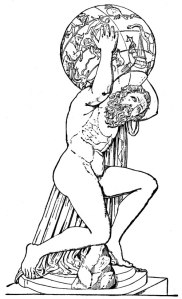
The Roman god Atlas holding up the world

Unless you are the Roman god Atlas, too much material in your work could put you at risk of not finishing it. (Image credit: public domain)

Luckily, there are remedies. Once creators have an idea in mind for a project, they can take steps to keep things at a manageable scale. Here are a few of those steps specifically aimed at writers. The technique essentially generates a simple outline.

Continue reading “How to Ensure You Finish Your Writing Project”

Stephen King’s Work Habits

One of the oldest battles in the arena of writing technique is the debate over outlining versus writing off the cuff. When I read Stephen King’s book, On Writing: A Memoir of the Craft, I learned he had some unusual ideas about how to get the work done. In fact, his work habits are so different from my own that I took the time to write up a little summary of how he went about things. While I carefully keep notes and create outlines, King just heroically plunges right in. For years, I believed that outlining was the most common approach to writing longer works, but wider experience on the web has taught me that a great many people come at writing in somewhat the same way as the famous horror writer. While King has his detractors, his remarkable output and amazing success indicate that his methods warrant some consideration.

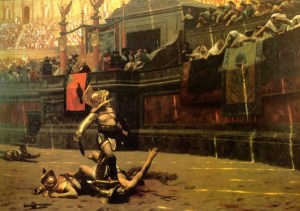
Jean-Leon Gerome's Famous Gladiator Painting (Pollice Verso) of 1872

Outline or extempore? Which writing gladiator do you favour? (Image: Wikimedia)

Continue reading “Stephen King’s Work Habits”

Creative Freedom Is Overrated

Many myths surround the creative process. One of these is the notion of creative freedom. It seems obvious that having a free rein could only be beneficial. So prevalent is the attitude that many contemporary creators will refuse to tackle a project that has restrictions. They turn up their noses and stalk haughtily away proclaiming that they could not possibly compromise their artistic vision and personal integrity by acquiescing to anything as philistine as limitations.

H. G. Wells

Where anything is possible, nothing is interesting. — H. G. Wells (Photo: public domain)

I am going to argue the counter-intuitive idea that restrictions are actually an asset. You may be surprised to learn that many famous creators share the point of view.

H. G. Wells expressed a related sentiment when he said, “Where anything is possible, nothing is interesting.” He was referring to stories, of course. He believed that a hero who could do anything or a situation where anything was possible meant there were no challenges to overcome, no obstacles to surmount, and no dangers to survive. Where is the interest in such a scenario? Who wants to read a story where there are no limits on what a hero can accomplish? Where is the suspense in a story based on the assumption that at any moment some miraculous turn of events will save the day? Only a story where the hero faces the possibility of humiliation, failure, or even death can engage the reader’s concern.

Continue reading “Creative Freedom Is Overrated”