The Desire for an Idealized Self

Both the religiously inclined and secular types strive to acquire a splendid false self. Between the two groups, the terminology may differ, but the game remains the same.
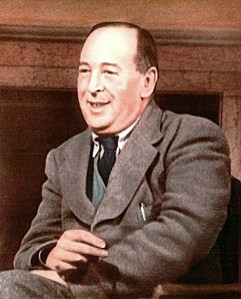
C. S. Lewis

The case of C. S. Lewis reveals that the desire for a splendid false self leads to self-alienation. (Photo: public domain)

English author and academic C. S. Lewis (The Chronicles of Narnia) experienced a sudden religious conversion while still a young man. He went on to become one of the 20th century’s best-known religious writers at a time when faith – in Europe, at least – was decidedly on the wane. Whatever one might say about his beliefs, Lewis is a superb example of how a skilled writer can win a following and find substantial success by going against the dominant trend. Conservative writers take note.

Continue reading “The Desire for an Idealized Self”

The Inner Nag vs. Inner Wisdom

In this post, I want to present another example of the associative workings of the unconscious mind. Years of strenuous psychotherapy and much “soul searching” have made me sensitive to the meaningful little clues and useful responses the unconscious scatters through our lives. We all have these experiences, but many of us, not understanding their potential value just shrug them off. I recorded this simple incident in one of my notebooks. To set the scene, I should mention that I was living the hermit’s life in a forest shack on the edge of the Canadian wilderness at the time.

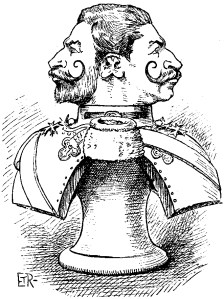
Two Faced Man

The human mind has two aspects, one of which can be a nag and the other a source of great wisdom. (Image: Gutenberg)

Continue reading “The Inner Nag vs. Inner Wisdom”

Imagination Can Stimulate Will

I have written several posts about authentic will and illuminated its roots in the psyche. As a way of discovering what you will, I have put forward the idea of employing resonance. That is, look around for those things that stir feelings of joy, delight, bliss or enchantment and there you will find what you truly want (will). This is so, because what you see or experience is resonating with (stimulating) your emotionally important ideas, the origin of will. Notice that, while your will comes from within, what I am suggesting relies on external objects, situations, activities, and so on. Personally, I like the realistic aspects of this approach. I am a big believer in actualities.

Phosphorescent Waves on a Maldives Beach at Night

Imagination can illuminate buried, forgotten, or neglected sources of joy and energize your life by putting will back into the picture. (Photo: public domain)

Continue reading “Imagination Can Stimulate Will”

Young H. G. Wells Exemplified the Struggling Writer

I am a devout lover of literary biographies and have read a great many over the years. My introduction to H. G. Wells came by way of Lovat Dickson’s book H. G. Wells; His Turbulent Life and Times. Dickson, a Canadian, lived for many years in London where he worked for the prestigious publishers Macmillan & Company. His job brought him into Wells’ circle and the two men became well acquainted. This publishing relationship allows Dickson to present Wells as a writer vividly.

Young H. G. Wells portrait photo

Young H. G. Wells is a good example of the writer of modest means struggling to write full time. (Photo: public domain)

Wells’ early days as a would-be author are a fascinating portrait of a young ambitious writer of limited means. Like many other lower-class writers of the late 19th century, Wells faced early poverty and waged long struggles with his family as he tried to break free of their limited worldview and escape from his lowly origins. Even now, it is still true that most families cannot conceive of writing as a legitimate career. Today’s young writers are still fighting the battles Wells had to fight.

Continue reading “Young H. G. Wells Exemplified the Struggling Writer”

Always Here If You Need Me Award

A grateful thank you to Phillip McCollum for nominating me for this interesting award. In his own acceptance post, Phillip says he’s horrible when it comes to following up on blog awards. His humble honest admission filled me with guilt. No one is more tardy with award follow-ups than I am. I got to thinking what a terrible person I must be (again). Then I realized that some of us are not comfortable shouldering a lot of praise. With this cunning piece of rationalization under my belt, I was saved from another round of depression — not to mention some nasty self-assessment!

Always Here If You Need Me Award
Yes, but am I always here because I’m reliable – or because I’m totally obsessive? (i.e. Are you sure you want to know me?)
Continue reading “Always Here If You Need Me Award”

Impatience Can Overwhelm Artistic Vision

Introduction

In prior posts, I have dealt with the importance of having a personal philosophy of writing. The elements of any writing philosophy must stand above a general preference for particular kinds of ideas for short stories and novels. More important, those elements should transcend considerations of writing technique such as plot, setting, characterization, style, and so on. All writers need an integrated package of powerful ideas geared towards such practical considerations as establishing productive work habits, maintaining standards, dealing with “writers block,” taming the inner critic, and just plain coping with the unforeseen.

Book with post haste as title

Patience prospers the creative process. Impatience can cripple it. (Image: public domain)

In this post, I want to supplement my earlier ideas by putting forward some thoughts on how to deal with the problem of impatience.

Continue reading “Impatience Can Overwhelm Artistic Vision”

Edgar Allan Poe, C. S. Lewis, and Monty the Cat

Introduction

For decades, I have loved reading sophisticated literary biographies and the personal diaries of famous writers and painters. This post outlines some thoughts prompted by reading, in close proximity, a biography of Edgar Allan Poe and C. S. Lewis’ diary. However, not everything I read is so substantial. During the sixteen-years I lived as a hermit on the edge of the Great Canadian Wilderness, I also acquired a taste for books written by people living in out of the way places. One of England’s great cat-lovers, Derek Tangye, became a surprise favourite. Tangye, an ex-newspaperman writes simple charming accounts of his life in Cornwall. He and his wife Jeannie lived in “Minack,” an ancient stone cottage perched atop a cliff on Cornwall’s south coast. They grew flowers for the London markets – and kept cats.

Edgar Allan Poe

Edgar Allan Poe could not put his troubled past behind him and move on. (photo: Wikipedia)

Continue reading “Edgar Allan Poe, C. S. Lewis, and Monty the Cat”

Coping with the Complexity of Writing

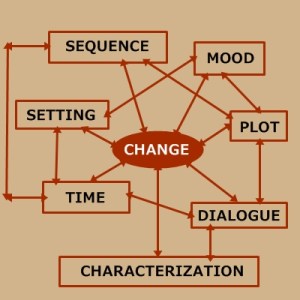
While conceptually simple, in actual practice, writing is a complicated art and all of the approaches involve some considerable degree of complexity. One of the most common reasons why writers fail is the inability to deal with the unforeseen knottiness of writing. To succeed, a writer must find manageable ways of dealing with the endless horrors of ramification or branching. Once a project is underway, any change we make in one place will usually lead to necessary changes in other places – often a great many other places. Since everything in a novel or story must remain consistent from start to finish, we must track down those places and make the needed changes. Then, of course, there is the likelihood that some of these secondary changes will necessitate further alterations of their own; and so on, in what can seem an endless tangle. If no plan is in place to deal effectively with the situation, the work will inevitably bog down – sometimes fatally.

Diagram of interrelated writing elements

Making even small changes in a piece of writing can lead to seemingly endless ramifications. (Image: Thomas Cotterill)

Continue reading “Coping with the Complexity of Writing”

Sherlock Holmes Disease

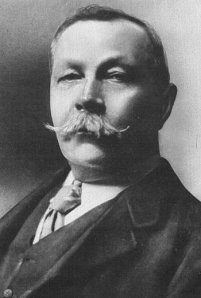
When Scottish physician and writer Arthur Conan Doyle created his fictional detective, Sherlock Holmes, he gave the immortal sleuth some character traits not considered virtues. Foremost among these dubious qualities would be Holmes’ chronic problem with boredom. Another negative behaviour, his cocaine habit, stems directly from this noteworthy inability to stay afloat in unstimulating situations. Doyle wished us to see that Holmes’ mind was so powerful it required huge amounts of intellectual “fuel” to keep it from stalling.

Arthur Conan Doyle

Arthur Conan Doyle used his famous character, Sherlock Holmes, to exemplify the perils of boredom for those with powerful intellects. (Photo: Wikipedia)

In reality, anyone with a decent mind faces the same situation. We know that all human beings tend towards “psychic entropy” when alone – the least stimulating situation a person can be in. It is less obvious that persons of greater intelligence may suffer the same fate even when among others if the milieu in which they travel is of insufficient sophistication. The danger is, as it was with Holmes, boredom followed by sudden descents into severe depression.

Continue reading “Sherlock Holmes Disease”

Replacing God’s Inner and Outer Comfort

When Christianity was strong in the West, the concept of God answered both the need for external physical protection and the interior need for something to account for that sense of the numinous most of us sense now and then. That is, God was, at the same time powerfully immanent in the cosmos and the comforting “God within our bosoms.” One could say that God was continuous across a boundary of objective outer and subjective inner life. People quite naturally felt a greater kinship with the world – or even the cosmos, if one included the crude conceptualization of the heavens extant at the time. Everything, including the human race was part of God’s Creation. The concept of the individual was not particularly well-developed.

The Hebrew Concept of God

God once provided both physical security and inner comfort. Now our needs are divided between the state and psychology. (Photo: public domain)

Continue reading “Replacing God’s Inner and Outer Comfort”