Recognizing patterns is a way of ordering, or seeing order in, the world. Spotting patterns can be a way of perceiving meaning, although we must remain aware that where there is a pattern there is notalways meaning. Maintaining a rational open-minded stance or avoiding the satisfying jump to conclusions can be surprisingly hard to do. Humans have evolved to notice patterns and ascribe, if not meaning, then at least significance, to them. English philosopher and scientist Francis Bacon said that humanity has a proclivity to “suppose the existence of more order and regularity in the world than it finds.”
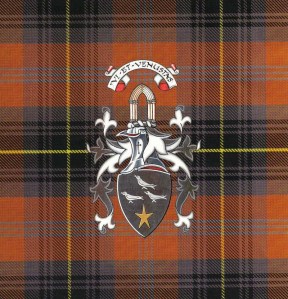
The tartan is a pattern without meaning (other than denoting clan) while the patterns on the coat of arms are heraldic and loaded with meaning. (Photo: dryburgh.us)
The Tower of Bones is book two of The Three Powers series and the sequel to The Snowmelt River. The novel continues the adventures of four young people from Earth (Alan, Kate, Mark, and Mo) as they struggle with their destinies in a savage sorcerous world called Tir. The physical action in a brooding romantic landscape that so characterized the first book in this marvellous series is at first replaced by skilfully-presented surreal inner struggles.
Charming, sinister, and exciting all rolled into one. The dazzling sequel to The Snowmelt River.
Tir’s powers of evil psychically probe and test Alan, the oldest of the four and bearer of an immense power he as yet does not know how to use. In this unequal battle, dream worlds predominate and much that happens is mental and subjective in nature. Psychic clashes flash across interior landscapes where humans are vulnerable and alone. The bright lights, vivid colours, and kaleidoscopic patterns suggest a special-effects extravaganza from a Hollywood movie. Visualized, mental, and imagined fireworks dazzle the mind.
In an earlier post on this topic, I stated that artists (of all kinds) develop their artistic vision by “examining and exploring the implications and ramifications of their personal vision of existence. In other words, they explore their philosophy of life.” The most powerful elements of a personal vision of existence or philosophy of life are the product of the creative person’s unique set of emotionally important ideas, which make up the self. High quality creativity springs from the struggle to attain self-knowledge and authenticity. Great literature, poetry, painting, and sculpture tells us something about life as the artist sees and experiences it. By recognizing, and then shining a light on, the archetypal aspects of their vision and their experience, artists include the illuminating sense of the universal in their work.
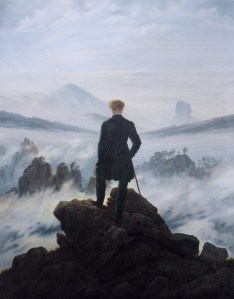
High level creators learn how to combine their own worldview with the process of self-discovery to develop their unique artistic vision. (image: wikipaintings)
The other day, I got to wondering why so many who obviously are politically correct deny being so when someone points out to them that they hold such views. I think the answer lies in the way most of us acquire our attitudes and opinions. Few of us are dedicated philosophers or deep thinkers so we form our opinions piecemeal, often over a considerable span of time. We do not suddenly buy into an established ideology or pre-packaged set of ideas. Most of us recognize the foolishness of such a thoughtless swallow-it-whole move.
It is possible to absorb politically correct (and other) attitudes without realizing what is happening. (Image: Thomas Cotterill)
Because of this piecemeal approach, participants in the politically correct worldview have probably absorbed the values one at a time as they encountered them. As is now well known, there is a strong leftist bias in education, the arts, the media, television, Hollywood, and so on. We meet political correctness everywhere. Such views are on the six o’clock news, embedded in sitcoms and dramas, presented in magazines and newspapers, flashed across the big screen in the latest Hollywood blockbusters, embedded in novels, and discussed on television talk shows. We may also encounter the worldview among our already-persuaded family members, friends, and co-workers. Seldom do these isolated examples of politically correct thinking bear the specific label “Politically Correct.” However, the notion that they are unquestionably a good thing is implicit in the mode of presentation. It is often very persuasive.
Back in January, the gothic-horror writer Lucinda Elliot nominated me for the Liebster Blog Award. I thank her sincerely for the honour. The long delay in putting up the acceptance post stems in part from a breakdown in my defences against manic-depressive illness. Things have been a bit rocky this year and the approaching equinox is only making things worse. (For those who may not know, manic-depressives are often sensitive to changes in the length of the day. This alters most rapidly near the spring and autumn equinoxes disturbing everyone’s brain chemistry to one extent or another and causing serious mood swings in the susceptible.)
Many thanks to Lucinda Elliot for her kind nomination.
A striking feature of socialist Europe is the proliferation of separatist movements. Growing numbers in Northern Ireland want to split from the UK and found a new nation called Ulster. Nationalists in Scotland also want to go it alone. Belgium’s Flemings (the Dutch) want independence and some Walloons (the French) have responded with a proposed state of their own (you cannot fire me, I quit!). Denmark’s Faroe Islands and Greenland both have independence movements. In France, there are separatist rumblings in Brittany, Corsica, and the Basque country. Catalonia has recently expressed its displeasure with being part of Spain. Germany’s Bavaria gets restless now and then. In fact, there are many such movements within most European countries, although not all of them must be taken seriously.
A preoccupation with ethnicity, minorities, and differences erodes national identities based on what a people have in common. (Photo: public domain)
Romantics like to think of themselves as unique individuals who have the strength of character to go against the flow. They describe anyone who stays in the mainstream as a “conformist,” a word with negative connotations.
Romanticism promotes an anti-social emphasis on individuality and self-absorption. (photo: public domain)
Academic and novelist Ann Swinfen has some interesting things to say about this topic as it relates to C. S. Lewis’sTheChronicles of Narnia. In her work of literary criticism, In Defence of Fantasy (1984), she points out that Lewis was against individualism and in favour of conforming to religious orthodoxy and societal norms. His fiction reflects this strongly held rational philosophy.
We had better start with a clear definition of the term, meme.
“Meme: (biology) a cultural unit (an idea, value, or pattern of behaviour) … passed from one person to another by non-genetic means (as by imitation)” (WordWeb).
SF writer Robert J. Sawyer often jokes that he is more interested in the survival of his memes than his genes. (Photo: sfwriter.com)
In other words, memes are the cultural counterpart of genes. Like genes, anyone can pass on his or her memes. Unlike genes, individuals who are willing to do the work can create memes.
Canadian science fiction writer Robert J. Sawyer has said on more than one occasion that, “… I like to quip that I’m more interested in the survival of my memes than my genes …” Sawyer knowingly works his memes into his stories and novels thereby making it possible for others to see and adopt them, and then, hopefully, pass them on yet again. Anyone who deliberately includes their own ideas and values in their work shares Sawyer’s openly expressed desire to spread his memes. However, they may be considerably less conscious of what they are doing. I want to play with the sometimes poorly understood impulse to spread one’s memes so let me pose a suggestive question.
The term “normal” once referred to the statistical idea of average (the norm), but in recent decades the word has acquired instead the medical connotation of “healthy.” Even the hard sciences are affected. In good science, the opposite of normal (abnormal) in the statistical sense means “not average”; that is, above average or below average. No judgement is implied. However, when one switches to the frame of reference acquired from medicine, the opposite of normal is “pathological,” and a value judgement is very definitely evident. This switch or drift in the meaning of normal has become practically universal and increasingly harmful.
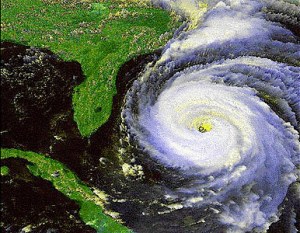
Weather is just one of many areas where we have lost sight of what constitutes normal. We now use a medical model rather than a statistical one. (photo credit: wpclipart.com)
The authentic self comprises the unique set of our most potent and precious emotionally important ideas. We acquire the basics of these mental constructs as children when, through our behaviour, our genes interact with our physical and social environment. Their uniqueness is what makes us all natural individuals. (Yes, without even trying, if we can stay out of our own way.) Unless we make them conscious – and we can – these assorted emotionally important ideas live in the unconscious where they generate our true will. We are all born with the urge for self-realization and the capacities we want to fulfil are an integral part of the authentic self.
Functional aspects of the authentic self may be compared to the working parts of an old-fashioned sailing ship. (Image freeclipartnow.com)
An old-fashioned sailboat or square-rigged ship makes a useful metaphor for illustrating the importance of our emotionally important ideas. (Or as some would say, subjectively formed guiding principles). Once we are aware of them, these ideas or principles give our “ship of self” a number of useful qualities:





 Thomas Cotterill